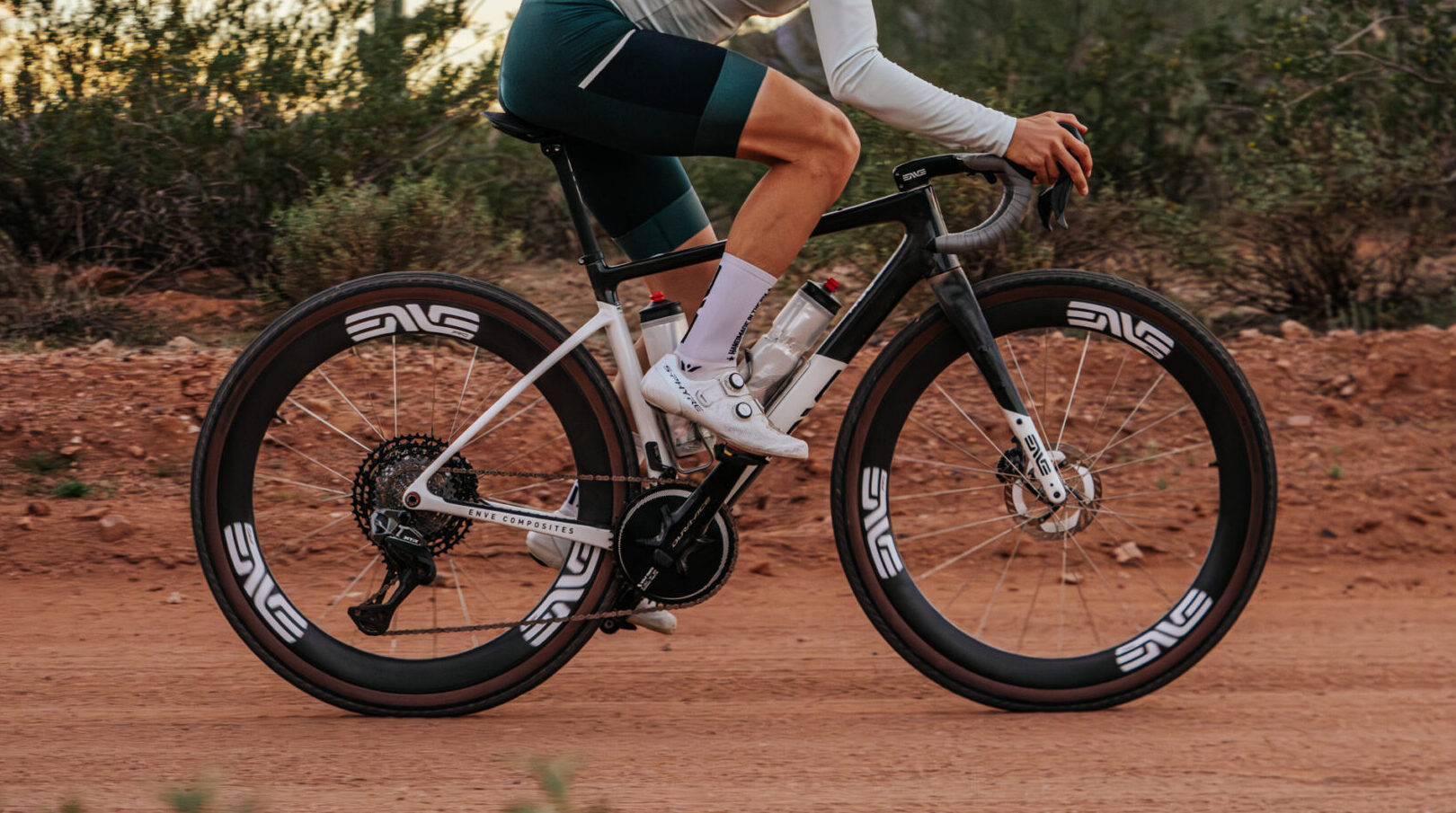
ENVE has flipped gravel-wheel design on its head — building the rim around fat 44–52mm tyres instead of the other way round — and claims up to 25 watts of free speed, but its new G SES range is heavy, eye-wateringly pricey and fussy about rubber.
What ENVE actually launched
ENVE's new G SES series is a ground-up gravel wheel range built for the way modern gravel bikes are actually ridden: on wide, high-volume tyres at race pace. Rather than shaping a tyre to suit a rim, ENVE optimised the rim profile around the tyre — a deliberate inversion of the traditional approach — and tuned the front and rear rims differently so each does its own aerodynamic job across a spread of wind angles.
There are three wheelsets. The flagship G SES 6.7 Pro pairs a 35mm internal width with mixed 60mm front / 67mm rear depths. The G SES 4.5 Pro and G SES 4.5 both run a 30mm internal width with 49mm front / 55mm rear depths; the split between them is build, not shape — different hubs, spokes and nipples. ENVE describes the 6.7 Pro as its "fastest gravel wheel ever" for fast, wide-open terrain, and the 4.5 as the more versatile all-rounder most people would ride every day.
By the numbers
Source: ENVE / Bikerumor
The design flip: rim around the tyre
The core idea is that a tyre is the leading aerodynamic surface on a gravel bike, so the rim should be shaped to flow cleanly into it — not fight it. That logic only works if you commit to genuinely wide rubber, which is why these rims are spec'd around 44–52mm tyres. ENVE pairs that with its Wide Hookless Bead, a reinforced edge designed to resist pinch flats and spread impact loads over a larger area.
The catch is that the philosophy cuts both ways. Fit a tyre that is too narrow and you lose the aero benefit and, ENVE warns, court reliability problems. As Bikerumor noted, tyre choice also drives the aero story as much as the rim does.
How the three models compare
G SES range at a glance
| G SES 6.7 Pro | G SES 4.5 Pro | G SES 4.5 | |
|---|---|---|---|
| Internal width | 35mm | 30mm | 30mm |
| Rim depth (front / rear) | 60 / 67mm | 49 / 55mm | 49 / 55mm |
| Wheelset weight | 1,580g | 1,480g | 1,565g |
| Recommended tyre | 44–52mm | 44–52mm | 44–52mm |
| Minimum tyre | 44mm | 40mm | 40mm |
| Hub | Innerdrive Pro | Innerdrive Pro | Innerdrive Premium |
| Spokes | Alpina Ultralite | Alpina Ultralite | Sapim CX-Ray |
| Price (USD, pair) | ~$3,100 (~R51 200) | ~$3,100 (~R51 200) | ~$2,800 (~R46 200) |
Specs: ENVE / Bikerumor
The aero numbers — and the asterisks
ENVE's headline claim is that the G SES is the world's most aero-efficient gravel wheel, with the 6.7 Pro saving roughly 8 watts at 32 km/h and up to 25 watts at 48 km/h against its AG25 baseline. Against the obvious benchmark — Zipp's 303 XPLR (32mm internal, 54mm deep) — BikeRadar reports the 6.7 Pro is 1.5 to 15 watts faster depending on yaw, and the 4.5 Pro 0.25 to 6 watts faster. Cyclist cites a 14.2% drag reduction for the 6.7 Pro at 48 km/h versus Zipp's 10.9%.
The honest caveat: those gains scale with speed. On a hilly course, or at the more pedestrian pace most of us actually ride gravel, the advantage shrinks fast — and the weight penalty starts to bite.
View data table
| Watts saved (claimed) | |
|---|---|
| 32 km/h | 8 W |
| 48 km/h | 25 W |
“At around 32 kph, the difference between slick and treaded tires is barely noticeable. But by the time you're pushing 50 kph, that gap grows to nearly 9 watts.”
What the reviewers think
Three outlets, three angles
Independent verdicts from across the cycling press — follow each link for the full review.
Skeptical on real-world fit
“I don't think either of these wide designs are at their optimum unless you opt for much bigger tyres.”
Read the full reviewFast, but heavy and fussy
“The 6.7 PRO hits 1,580 grams, and Enve openly admits that's the line—any heavier and it becomes a liability.”
Read the full reviewAero, with a catch
“Significantly heavier than a modern high-end all-rounder.”
Read the full reviewThe reviews converge on a single theme: ENVE bought aerodynamics with mass and with strict tyre constraints. Cycling Weekly even points out that part of the aero edge comes from ENVE sticking with steel spokes where rivals are moving to carbon — calling it, only half-jokingly, "a cheat code." Nobody disputes the wind-tunnel story; they question how often the average rider is going fast enough on smooth enough ground to cash it in.
The honest balance sheet
- Class-leading claimed aero — up to 25W at 48 km/h vs ENVE's baseline
- Genuinely wide (30–35mm internal) and purpose-built for 44–52mm tyres
- Wide Hookless Bead aimed squarely at pinch-flat resistance
- Premium Innerdrive Pro hubs with ceramic bearings on Pro builds
- Differentiated front/rear rim shapes tuned across wind angles
- Heavy for the category at 1,480–1,580g a pair
- Fussy tyre compatibility: 40/44mm minimums and a 50 psi ceiling
- Aero gains only really pay off at high, sustained speeds
- Very expensive — about $3,100 (~R51 200) a pair for either Pro model
- Aero advantage partly leans on steel (not carbon) spokes
Pricing and where to find them in SA
ENVE prices the Pro models at US$1,400 (~R23 100) (front) + US$1,700 (~R28 100) (rear) — about US$3,100 (~R51 200) a pair, or roughly £3,499 (~R76 100) / €3,899 (~R73 100) — with the standard G SES 4.5 landing near US$2,800 (~R46 200). South African retail will carry import duty and currency markups on top, so treat overseas figures as a guide only and check live local listings below.
Tap to vote — see how readers lean
Buyer questions, answered
What tyres do the ENVE G SES wheels need? +
They're optimised for 44–52mm tyres. The minimum is 44mm on the 6.7 Pro and 40mm on the 4.5 models, with a 50 psi / 3.4 bar maximum pressure. Run anything narrower and you lose the aero benefit and risk pinch flats.
How much faster are they, really? +
ENVE claims about 8 watts saved at 32 km/h and up to 25 watts at 48 km/h versus its AG25 baseline. The gains scale with speed, so on hilly courses or at moderate pace the real-world benefit is much smaller.
Are they hookless? +
Yes — they use ENVE's Wide Hookless Bead. Fit tubeless tyres that are explicitly hookless-approved and respect the 50 psi pressure ceiling.
Should I get the 6.7 Pro or the 4.5? +
Choose the 6.7 Pro for fast, wide-open racing where aero is king. The 4.5 (Pro or standard) is the more versatile, better-handling all-rounder — and the 4.5 Pro is actually the lightest wheel in the range at 1,480g.
How much do they cost? +
About US$3,100 (~R51 200) a pair for either Pro model (roughly £3,499 (~R76 100) / €3,899 (~R73 100)) and around US$2,800 (~R46 200) for the standard G SES 4.5. South African pricing varies with import duty — check the live listings above.
Sources & further reading
- ENVE G SES Wheels Go Wider & Fully Aero for Gravel — Bikerumor
- "Huge aerodynamic opportunity" – the widest gravel wheelset we've ever seen — BikeRadar
- Enve's New Gravel Wheels Are Fast, Heavy, and Picky About Tires — Gear & Grit
- Enve claims its new G Series gravel wheels are the world's most aero-efficient — Cyclist
- Enve's fastest-ever gravel setup — the G SES all-road range — Cycling Weekly
- G SES 4.5 Pro — official specifications — ENVE Composites
The ENVE G SES range is a genuinely clever piece of engineering — rims shaped around the tyre, real wind-tunnel gains, and a hookless bead built for big-volume gravel rubber. But it is unapologetically a fast-course race wheel: heavy for the class, strict about tyres, and only worth its aero premium if you spend real time at 40km/h-plus on open terrain. If you live in the hills or want one wheelset for everything, lighter, friendlier options make more sense. If you pin numbers on fast gravel, this is the new benchmark to beat — at a price to match.


