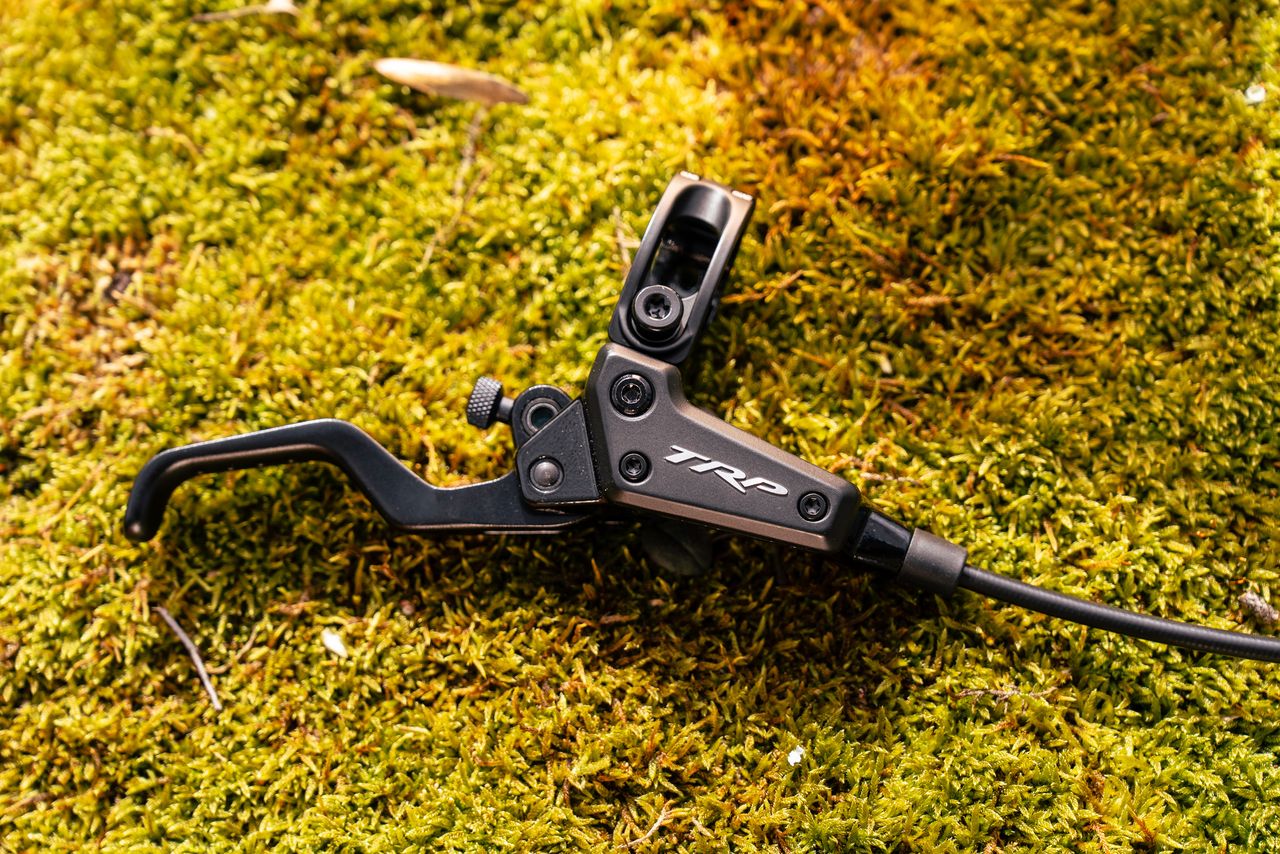
TRP has stretched its World Cup-proven EVO brake platform down to two cheaper 4-piston stoppers — the $224.99 (~R3 700) EVO Expert and $169.99 (~R2 800) EVO Comp — while quietly retiring the Trail EVO and Slate EVO.
What TRP just launched
TRP (Tektro's performance arm) has built the EVO line into one of the more talked-about brake families in mountain biking, largely on the back of the gravity-focused DH-R EVO and the do-it-all EVO Pro. The pitch has always been the same: develop a feature at the very top — proven on World Cup downhill and XC circuits — then cascade it down the range so power and modulation stay consistent at every price.
The two new arrivals, the EVO Expert and EVO Comp, are the cheapest seats in that grandstand. Both are full 4-piston brakes aimed at trail and eMTB riders, and both slot in beneath the Pro while inheriting its calipers, 2.3 mm rotors and mineral-oil internals. The headline is accessibility: TRP is trying to put hybrid-piston, race-derived braking on bikes that previously made do with entry-level stoppers.
Expert vs Comp: where they differ
The split between the two is deliberate. The EVO Expert ($224.99 (~R3 700)) sits closest to the Pro — it runs the same hybrid alloy/ceramic pistons for heat management and adds tool-free reach adjustment, but loses the Pro's tool-free pad-contact (PAD) dial. It's black-only.
The EVO Comp ($169.99 (~R2 800)) is the stripped-back one. Inside the caliper the hybrid pistons are swapped for plain alloy, and while you still get reach adjustment, it now requires a tool. No pad-contact adjuster, black-only again. As Bikerumor's Travis Reill puts it, the Comp keeps the power but drops the "bells and whistles." Both keep the die-cast alloy lever, where the Pro steps up to a forged 6061-T6 unit.
By the numbers
Source: Bikerumor
How the new pair stacks up against the EVO Pro
| EVO Comp | EVO Expert | EVO Pro | |
|---|---|---|---|
| Price (USD MSRP, per brake) | $169.99 (~R2 800) | $224.99 (~R3 700) | $307.99 (~R5 100) |
| Pistons | Alloy | Hybrid alloy/ceramic | Hybrid alloy/ceramic |
| Lever material | Die-cast alloy | Die-cast alloy | Forged 6061-T6 |
| Reach adjust | Tool needed | Tool-free | Tool-free |
| Pad-contact adjust | No | No | Yes (PAD dial) |
| Claimed weight (g, set) | 659 | 678 | 632 |
| Colours | Black | Black | Black / Silver / Gold |
| Rotor | 2.3 mm | 2.3 mm | 2.3 mm |
Specs: Bikerumor & Bikepacking.com
The price ladder
Stacked up, the EVO range now reads as a clean ladder from the 2-piston XC brake to the gold-anodised flagship. The two newcomers undercut the Pro by a meaningful margin — the Comp lands roughly 45% cheaper than a black EVO Pro — which is the whole point of the exercise.
View data table
| USD MSRP | |
|---|---|
| EVO Comp | 169.99 USD |
| EVO X | 197.99 USD |
| EVO Expert | 224.99 USD |
| EVO Pro | 307.99 USD |
In Rand (approx, @ today's rate): EVO Comp: ~R2 800 · EVO X: ~R3 300 · EVO Expert: ~R3 700 · EVO Pro: ~R5 100
What the reviewers are saying
Four outlets, four angles
Independent verdicts from across the cycling press — follow each link for the full review.
The platform the Comp & Expert inherit
“The intuitive control of the power gives confidence on trail in all scenarios.”
Read the full reviewOn the EVO Comp's simplicity
“A functional, robust solution with tool-assisted reach adjustment – designed for maximum simplicity and consistent performance.”
Read the full reviewReads it as a tidy-up of the range
“TRP's approach simplifies the EVO offerings.”
Read the full reviewFrames it as a value move
“The 2026 TRP EVO brakes aim for high performance at an entry-level price.”
Read the full review“It doesn't take much effort to lock up the wheels, and I can corroborate TRP's claims of increased power.”
The trade-offs
EVO Comp & Expert at a glance
- Genuine 4-piston power and the EVO platform's modulation at a much lower price.
- Hybrid pistons on the Expert help keep lever feel consistent on long, hot descents.
- Tool-free reach adjust on the Expert; shared 2.3 mm rotors and mineral oil across the range.
- The cheaper Comp is reportedly lighter than the dearer Expert (claimed ~659 g vs ~678 g set).
- No tool-free pad-contact (PAD) dial on either — you give up the Pro's signature adjustability.
- Both new brakes are black-only; no silver or gold like the Pro.
- The Comp's reach adjuster needs a tool, so on-the-fly tweaks are out.
- Prices are USD MSRP — South African pricing and availability are still to be confirmed.
What's leaving the lineup
The EVO family, sorted
- Long-runningDH-R EVO
TRP's gravity flagship and the brake the modern EVO family grew from — confirmed to stay in the lineup.
- Modern platformEVO Pro & EVO X
Pro is the do-it-all 4-piston flagship (tool-free PAD dial, from $307.99 (~R5 100)); EVO X is the 2-piston XC/down-country brake (from $197.99 (~R3 300)).
- 2026 — newEVO Expert & EVO Comp
Hybrid-piston Expert ($224.99 (~R3 700)) and alloy-piston Comp ($169.99 (~R2 800)) extend the range downwards.
- Phasing outTrail EVO & Slate EVO
Both discontinued; the Trail EVO stays an OE spec on select complete bikes for one more year.
On paper, dropping hybrid-piston, World Cup-derived braking to under $230 (~R3 800) is a strong value move — just temper expectations on adjustability and finishes versus the Pro. This is our editorial read of the proposition, not a tested score.
Should you buy in?
Tap to vote — see how readers lean
Common questions
What's the actual difference between the EVO Comp and EVO Expert? +
Pistons and reach adjustment. The Expert ($224.99 (~R3 700)) uses hybrid alloy/ceramic pistons and a tool-free reach adjuster; the Comp ($169.99 (~R2 800)) uses plain alloy pistons and a reach adjuster that needs a tool. Neither gets the Pro's pad-contact dial, and both are black-only.
Will they work with my existing rotors and pads? +
Both are 4-piston brakes designed around 2.3 mm rotors and use TRP Performance mineral oil with a top-loading pad design. Check your rotor thickness and mount standard before mixing parts; TRP specs the thicker 2.3 mm rotor for heat management.
Why do hybrid pistons matter on the Expert? +
The hybrid alloy/ceramic pistons resist heat transfer better than plain alloy, which helps keep lever feel and bite consistent on long, hot descents — the same reasoning behind the flagship EVO Pro's pistons. The Comp trades that down to alloy to hit its price.
Can I run these on an eMTB? +
Yes — TRP positions the EVO Expert for demanding trail and eMTB use, and the full 4-piston caliper plus 2.3 mm rotor are built for the extra weight and sustained heat e-bikes generate.
What will they cost in South Africa? +
There's no confirmed ZAR RRP yet — the $169.99 (~R2 800)/$224.99 (~R3 700) figures are US MSRP per brake. We won't quote a rand price until stock lands in our catalogue; use the price-watch widget above for live local pricing as it appears.
Sources & further reading
- TRP Introduces Two New 4-Piston Brakes to the EVO Family — Bikerumor (Travis Reill)
- The 2026 TRP EVO Brakes Aim for High Performance at an Entry-Level Price — Bikepacking.com
- Racing DNA for the trail: New TRP EVO Expert and EVO Comp brakes — Velomotion
- TRP EVO Pro Brakes — Explained + Initial Review — The Lost Co.
- EVO Expert MTB Brake — official product page — TRP Cycling
- TRP EVO Brake Family — What's the Best Brake for You? — TRP Cycling
If you've wanted TRP's distinctive, modulation-first braking but balked at the Pro's price, the EVO Comp and Expert are the obvious way in. The Expert is the sweet spot for most trail and eMTB riders — hybrid pistons and tool-free reach for $224.99 (~R3 700) — while the Comp is the budget hero at $169.99 (~R2 800) if you can live without the toolless reach dial and the PAD adjuster. Both are still per-brake USD MSRP, so the real question for local buyers is where rand pricing lands. Watch this page for the South African number.


