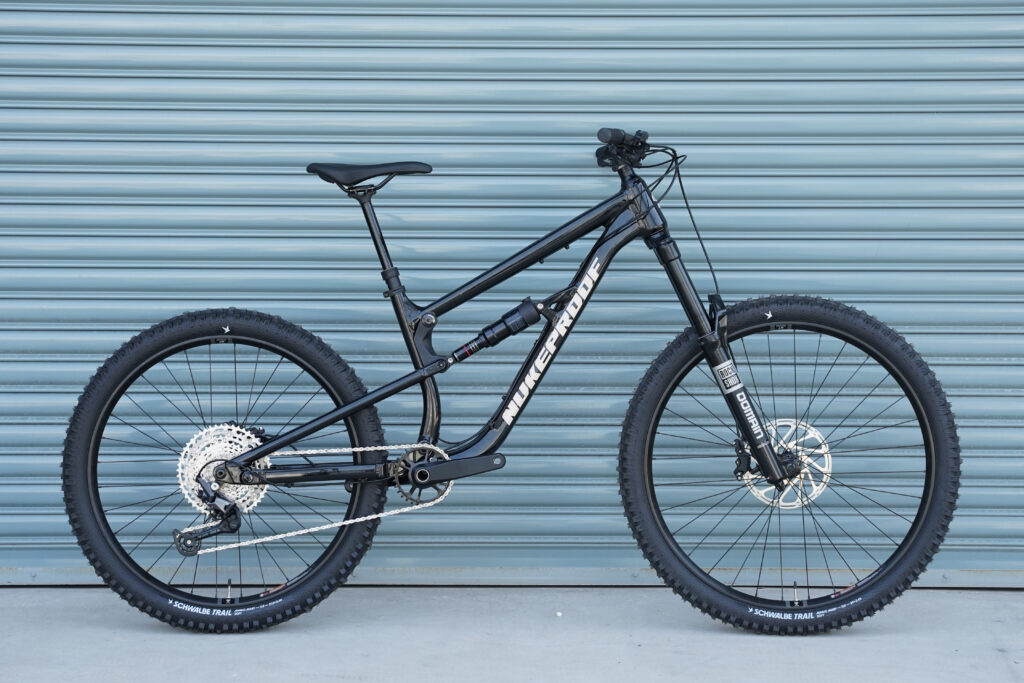
Forbidden's first bike without an idler or a high pivot is a 120mm downcountry trail weapon, and its size-proportional chainstays might be the most interesting geometry idea of 2026.
What the Reya actually is
Forbidden built its name on rearward axle paths: high-pivot, idler-equipped bikes like the Druid and Dreadnought that pull the rear wheel up and back over square-edged hits. The Reya throws that signature out the window. It is the Canadian brand's first bike with no idler and no high pivot, a 120mm-rear / 130mm-fork short-travel trail bike built on a conventional Horst-link four-bar.
The category is the fashionable one everyone argues about: downcountry, XC efficiency with trail-bike attitude. Forbidden would rather you didn't call it that. The brand frames the Reya not as an XC race bike with extra travel bolted on, but as a ground-up trail bike that happens to be light.
Forbidden Reya by the numbers
Source: Forbidden Bike Company
The big idea: chainstays that grow with the frame
The Reya's headline trick is its chainstays. Under Forbidden's OneRide philosophy the rear-centre length is drawn to scale for every frame size, from a stubby 420mm on the smallest S1 to a long 464mm on the S4. Most brands run a single chainstay length across the whole range, which leaves short riders sitting over the back wheel and tall riders hanging off the front.
By growing the back of the bike in step with the front (reach runs 435mm to 495mm), Forbidden aims to keep the rider's weight in the same spot between the wheels whatever their height, so an S1 and an S4 are meant to corner, climb and manual with the same balance.
View data table
| Rear centre (mm) | |
|---|---|
| S1 | 420 mm |
| S2 | 435 mm |
| S3 | 449 mm |
| S4 | 464 mm |
Suspension: TRIFECTA, minus the idler
Underneath, the new Trifecta V3 layout is a classic Horst-link four-bar with the shock mounted vertically under the top tube for torsional stiffness and a low centre of mass. Forbidden quotes roughly 110% anti-squat at sag in the climbing gears, enough to stay calm and efficient under power without locking the wheel off the ground, and a steady ~80% anti-rise to keep the rear active under braking.
The leverage curve is progressive and smooth, and chain feedback is tuned to add tension in the climbing gears and shed it in the harder gears for a freer-feeling descent. No idler means less drivetrain drag and noise, plus one fewer wearing part to service.
What the first looks say
Independent verdicts from across the cycling press — follow each link for the full review.
Back to basics
“Stepping away from a high-pivot, the Forbidden Reya features a good 'ol-fashioned four-bar suspension platform.”
Read the full reviewNot an XC bike
“This is not an XCO bike with pumped-up travel. It is a bike built from the ground up to maximise fun and speed.”
Read the full reviewTuned for both ways
“Forbidden fine-tuned the chain feedback to provide more tension in climbing gears for stability and less in harder gears for an effortless feel on descents.”
Read the full reviewBuilds, weights and what it costs
Reya build tiers compared
| Tier 3 | Tier 2 | Tier 1 | |
|---|---|---|---|
| Price (USD) | $6,299 (~R104 000) | $7,699 (~R127 000) | $10,499 (~R173 000) |
| Fork | RockShox Pike Select+ | RockShox Pike Ultimate | Fox Factory 34 SL |
| Shock | RockShox Deluxe Select+ | RockShox Deluxe Ultimate | Fox Factory Float |
| Drivetrain | SRAM Eagle 90 T-Type | SRAM GX T-Type | SRAM XX SL T-Type |
| Brakes | SRAM Motive Bronze | SRAM Motive Silver | SRAM Motive Ultimate |
| Wheels | DT Swiss 370 / 1900 alloy | DT Swiss 350 / 1700 alloy | DT Swiss 240 / 1500 carbon |
| Claimed weight (S2) | 13.02 kg / 28.7 lb | — | 11.74 kg / 25.88 lb |
View data table
| Price (USD) | |
|---|---|
| Tier 3 | 6299 $ |
| Tier 2 | 7699 $ |
| Tier 1 | 10499 $ |
In Rand (approx, @ today's rate): Tier 3: ~R104 000 · Tier 2: ~R127 000 · Tier 1: ~R173 000
The case for and against
- Truly proportional rear-centre (420mm S1 to 464mm S4) keeps weight balance consistent across the size range
- Drops the idler and high pivot: simpler, quieter, less drivetrain drag and one fewer part to service
- Threaded BSA bottom bracket and full-complement bearings biased toward durability
- Progressive leverage with ~110% anti-squat for an efficient, composed climber
- SRAM T-Type transmission on every build and room for a full-size bottle on all sizes
- Premium pricing: entry Tier 3 is US$6,299 (~R104 000), top Tier 1 US$10,499 (~R173 000), before SA import duties and shipping
- No in-frame storage and only a single bottle mount
- A proper linkage bike rather than a flex-stay featherweight, so heavier than the lightest XC rigs (Tier 1 ~11.74 kg)
- No South African distributor we can confirm yet: grey-import territory for now
- 29 x 2.6in maximum tyre clearance is generous but not plus-bike roomy
A genuinely clever short-travel platform, with proportional sizing as the standout idea. Priced as a premium import and not yet locally supported. This is a first impression from published specs and first looks, not a ride test.
Should South African riders care?
There is no Forbidden distributor we can confirm in South Africa, so a Reya is grey-import territory for now, and the US$6,299 (~R104 000) to US$10,499 (~R173 000) sticker lands before shipping, duties and VAT. That said, the recipe is very SA-friendly: our long-climb, fast-descent terrain (think W2W, the Tankwa, Jonkershoek and Karkloof) is exactly the brief the Reya was drawn for.
And while the complete bike is an import, almost every component on it (RockShox Pike, Fox 34 SL, SRAM Eagle/GX/XX Transmission, DT Swiss wheels and Maxxis Rekon Race rubber) is sold locally, so the spec is easy to price up or replicate here. Our tracker above pulls live South African prices on those parts.
Tap to vote — see how readers lean
Forbidden Reya: your questions
Is the Reya an XC bike or a trail bike? +
It sits between the two, the downcountry / short-travel trail space. It pairs XC-light 120mm rear / 130mm fork travel with trail geometry: a slack 65 degree head angle and a 77 degree effective seat angle across all sizes.
What are proportional chainstays and OneRide geometry? +
Forbidden scales the rear-centre length to each frame size, 420mm on the S1 up to 464mm on the S4, rather than using one length for every rider. The goal is identical weight balance and handling whatever your height.
Why did Forbidden drop the idler and high pivot? +
The brand prioritised suspension feel and pedalling efficiency over a rearward axle path on this bike, choosing a conventional Horst-link four-bar. That means less drivetrain drag and noise and simpler maintenance than its idler bikes.
What does the Reya weigh? +
The S2 carbon frame is a claimed 2.27 kg without a shock. Complete bikes run from about 11.74 kg (25.88 lb) for the Fox-equipped Tier 1 to roughly 13.02 kg (28.7 lb) for the entry Tier 3, both in S2.
Can I buy a Forbidden Reya in South Africa? +
There's no confirmed local distributor yet, so it would likely be a personal import with duties and VAT on top of the USD price. The components it's built from, however, are widely available from SA retailers.
Sources & further reading
- The New Forbidden Reya is for Downcountry — Bikepacking.com
- Reya: official spec & geometry — Forbidden Bike Company
- Forbidden Reya: short-travel, no idlers or high-pivots — Bikerumor
- Forbidden Reya first look — Outset
- Meet the Forbidden Reya — Worldwide Cyclery
- First Look: The Forbidden Reya is Not Your Ordinary XC Bike — Pinkbike
The Reya is the most conventional bike Forbidden has ever made and, paradoxically, one of its most interesting. Ditching the idler and high pivot is a confident move from a brand that built its identity on them, and the proportional chainstays are a genuinely thoughtful answer to a problem most makers ignore.
For South African riders it's an aspirational grey import for now rather than a showroom buy, but as a blueprint for a one-bike quiver-killer on our long-climb, fast-descent trails, the Reya is bang on the brief. Watch this space for a local distributor, and a proper ride review.